

Contractors planning a crane lift in Massachusetts need to account for both federal OSHA requirements and Massachusetts hoisting-machinery rules. For construction cranes, OSHA 29 CFR 1926 Subpart CC sets the federal framework, while Massachusetts regulates hoisting machinery and operator licensing under M.G.L. Chapter 146 and 230 CMR 6.00.
That last citation is worth noticing.
Massachusetts moved its hoisting-machinery regulation from 520 CMR 6.00 to 230 CMR 6.00 in November 2025. If an older safety plan, contract, or training document still references 520 CMR 6.00, it is using the former numbering.
At Aerial Crane Service, we deal with these requirements as part of planning lifts for contractors throughout Massachusetts. Our Massachusetts crane service starts with the load and site, then works through crane selection, setup, rigging, access, hazards, and the coordination required to perform the lift.
This article is a contractor’s working overview. The exact requirements still depend on the crane, job, location, and work being performed.
Massachusetts Crane Rules Start With Two Regulatory Systems
Federal OSHA and Massachusetts do different jobs.
OSHA’s Subpart CC establishes federal construction requirements for cranes and derricks.
It covers areas including:
- ground conditions;
- crane assembly and disassembly;
- power-line safety;
- equipment inspections;
- work-area controls;
- load handling;
- operator qualification and evaluation;
- signal persons;
- personnel hoisting;
- equipment modifications.
Massachusetts then adds state licensing and operating requirements for hoisting machinery.
For contractors, that means federal compliance does not replace the Massachusetts license requirement, and a Massachusetts license does not eliminate OSHA’s employer responsibilities.
We plan around both.
The Current Massachusetts Regulation Is 230 CMR 6.00
A lot of material still circulating online says 520 CMR 6.00 Hoisting Machinery.
That was the previous citation.
As of November 21, 2025, Massachusetts identifies the hoisting-machinery regulation as 230 CMR 6.00.
The regulation is administered through the Division of Occupational Licensure and the Office of Public Safety and Inspections.
It addresses operator licensing, temporary permits, license classifications, safe operating procedures, inspections, incident reporting, and special requirements for different categories of hoisting machinery.
For a 2026 project, we would use 230 CMR 6.00 in current project documentation.
Do Not Rely on the Old 500-Pound and 10-Foot Rule by Itself
Contractors sometimes remember Massachusetts hoisting law as:
“If it lifts more than 500 pounds higher than 10 feet, you need a hoisting license.”
That shortcut came from older regulatory language.
The current regulation describes hoisting machinery by equipment type and classification and includes specific thresholds and exemptions for certain equipment.
It expressly includes equipment such as tower cranes, lattice-boom cranes, telescoping-boom cranes, telehandlers, excavators, backhoes, loaders, compact hoisting machinery, overhead gantry cranes, and other covered equipment.
The better approach is to identify the machine you intend to operate and confirm the Massachusetts license restriction that covers it.
Do that before the operator arrives at the job.
Massachusetts Hoisting Licenses Are Equipment-Specific
Massachusetts divides hoisting licenses into classes and restrictions.
For crane contractors, Class 1 is the category we encounter most often.
Class 1A
Class 1A includes friction-clutch machines, derricks, tower cranes, lattice booms, and equipment covered by several lower classifications.
Class 1B
Class 1B covers equipment with telescoping booms and wire rope.
Class 1C
Class 1C covers hydraulic telescoping-boom equipment and other hydraulic equipment designed for hoisting, excluding equipment with wire-rope hoist lines.
Class 1D
Class 1D covers general industrial warehouse forklifts primarily used indoors.
Massachusetts also has separate classifications for excavating equipment, electric and pneumatic equipment, and specialty machinery.
The operator’s license needs to match the equipment being operated.
A Massachusetts Hoisting License Is Not the Same Thing as OSHA Operator Evaluation
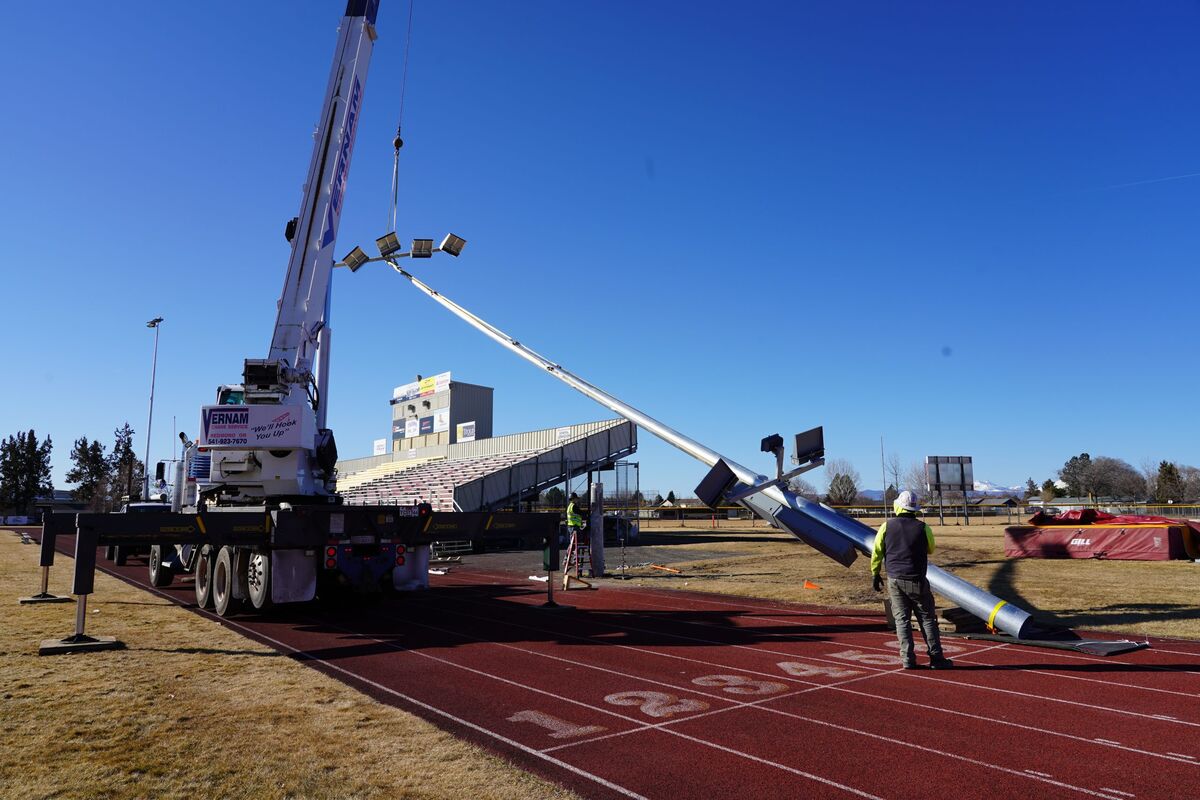
This is an important distinction for general contractors and crane employers.
OSHA requires covered operators to be trained, certified or licensed, and evaluated.
When a state licensing program satisfies OSHA’s requirements, the state license can satisfy the applicable operator-licensing component within that jurisdiction.
The employer still has to evaluate the operator.
That evaluation addresses the operator’s skills, knowledge, ability to recognize and avoid risk, and ability to handle the size and configuration of equipment assigned.
Configuration matters.
Boom length matters.
Attachments matter.
Counterweight configuration matters.
The type of hoisting activity matters.
A card in a wallet does not tell the employer everything OSHA requires it to know about the operator assigned to a particular lift.
Massachusetts Hoisting Licenses Renew Every Two Years
Massachusetts hoisting engineer licenses must be renewed every two years.
Applicants for a regular hoisting license must be at least 18 years old and satisfy the state’s application and examination requirements.
Continuing education is part of renewal.
For Class 1A, 1B, and 1C licenses, the current regulation requires at least two classroom hours of continuing education for renewal: one hour addressing regulatory and industry-standard material and one hour of equipment-specific training.
That training includes Massachusetts law, 230 CMR 6.00, OSHA standards, and other relevant requirements.
OSHA Certification Can Run on a Different Cycle
Federal OSHA’s certification framework can use a different expiration period.
For example, certification from an accredited crane-operator testing organization under OSHA 1926.1427 is valid for five years.
A compliant government license is recognized for the period established by the licensing authority, subject to OSHA’s maximum period under the federal rule.
Massachusetts renews its hoisting license every two years.
For a Massachusetts lift, we care about what is currently required for the jurisdiction and the employer, not which credential has the longer expiration date.
Keep the Massachusetts License With the Operator
Massachusetts law requires the hoisting license or temporary permit to be carried by the operator while operating hoisting machinery.
Current 230 CMR 6.00 also requires the operator to carry government-issued identification with the license and make the documents available when requested by an inspector or other authorized state official.
For a contractor preparing a site, checking operator credentials before the scheduled lift is easier than discovering a problem after the crane is set.
Ground Conditions Are Part of Crane Compliance
The crane can be sized correctly and still have a bad setup.
OSHA makes ground conditions a specific part of Subpart CC.
On projects with a controlling entity, that entity has responsibilities for providing sufficiently firm, drained, and graded ground so that the crane can be assembled and operated according to manufacturer requirements.
The controlling entity also has to communicate known underground hazards in the setup area.
That can include:
- utility vaults;
- buried tanks;
- old foundations;
- voids;
- utilities;
- poorly compacted fill;
- recent excavations.
Those conditions matter because outriggers transfer large forces into relatively small areas.
A parking lot that holds delivery trucks every day may still need evaluation before it supports an outrigger reaction from a loaded crane.
The Contractor Should Tell Us What Is Under the Setup Area
We cannot evaluate something nobody knows is there.
When we plan a lift, tell us about known underground conditions near the proposed crane setup.
Site drawings help.
As-builts help.
Utility plans help.
So does knowledge from the superintendent who watched the site get backfilled six months earlier.
Our safe crane lift planning process looks at the entire setup, including ground support and known subsurface conditions, before the lift starts.
Outriggers Need More Than an Open Parking Space
Massachusetts 230 CMR 6.00 requires outriggers and stabilizers to be used with adequate blocking according to manufacturer specifications or surface conditions.
The setup area has to provide enough room for the crane configuration being used.
That means we need to account for the crane itself, outrigger spread, support material, counterweight clearance, boom movement, and access for the rest of the job.
If cars, dumpsters, stored material, or other trades are occupying that space when the crane arrives, the lift may not be ready.
Send us the setup conditions early.
Load Charts Stay With the Crane
Massachusetts requires manufacturer load charts and operating manuals to remain with the hoisting machinery.
For cranes, the applicable load chart has to be available to the operator.
This is more than paperwork.
Crane capacity changes with configuration.
The same crane may have very different allowable loads depending on:
- working radius;
- boom length;
- boom angle;
- counterweight;
- outrigger configuration;
- attachments;
- reeving and operating setup.
That is why asking only for “the crane tonnage” does not give us enough information to plan a lift.
Rated Capacity Depends on Radius
A 100-ton crane does not lift 100 tons everywhere the hook can reach.
As the working radius increases, available capacity usually decreases.
Building height can push the required boom length farther out.
A parapet can change the lift path.
A rooftop unit set near the far side of a building may require much more crane than the same unit set close to the crane.
When we review a contractor’s lift, we want the load weight, pick point, set point, horizontal radius, required height, and known obstacles.
Our guide on load weight, center of gravity, and lift points explains why the number printed on the shipping paperwork is only the beginning of the rigging and crane-capacity discussion.
Do Not Guess the Load Weight
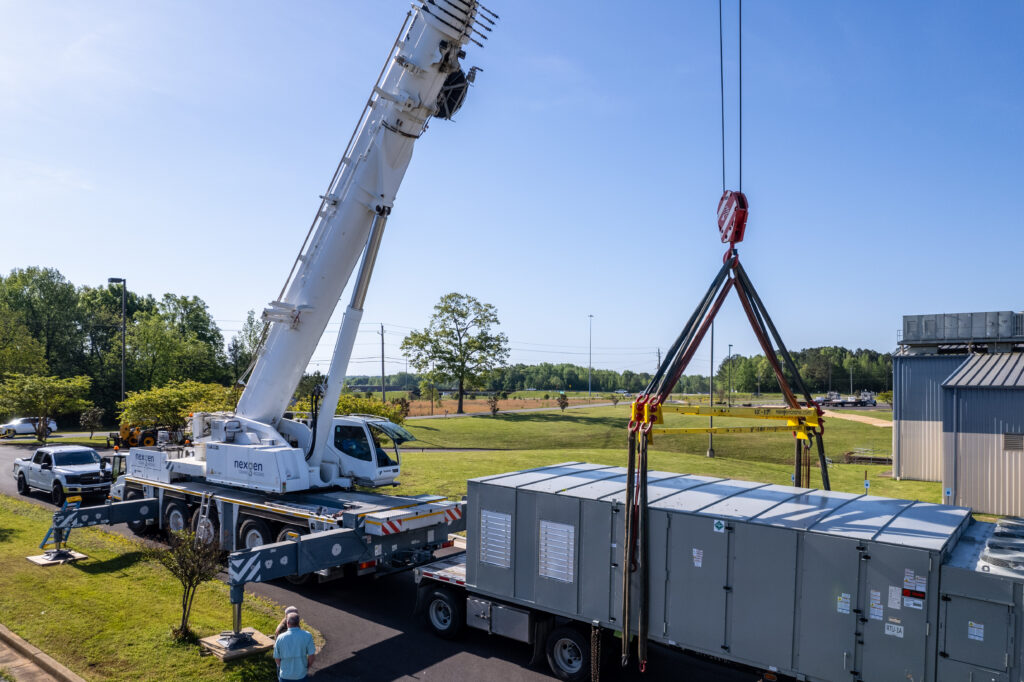
A lift plan works better when load information comes from something we can rely on.
That may be:
- manufacturer documentation;
- approved shop drawings;
- engineering documents;
- equipment data;
- verified calculations;
- an appropriate weighing method.
Guessing based on what a similar unit weighed is a poor way to start.
Accessories can change weight.
Fluids can change weight.
Packaging or temporary structural material can change weight.
A replacement unit may be heavier than the unit being removed from the same curb.
Give us the best available load information before crane selection is finalized.
Rigging Has Its Own Capacity Limits
Crane capacity does not compensate for undersized rigging.
Slings, shackles, hooks, lifting beams, spreader bars, and other components have their own working load limits.
Sling angle also changes the force in each leg.
The load’s center of gravity influences how it will hang once the crane takes the weight.
Our spreader bars and specialty rigging are selected around the actual load geometry and lift plan.
We want that arrangement established before the load is hanging from the hook.
Lift Points Need to Be Known Before the Pick
Some loads have clearly designated lifting lugs.
Others require engineered lifting points or manufacturer instructions.
A piece of equipment that is strong while sitting on a slab is not automatically designed to accept lifting force anywhere a sling can be wrapped around it.
For modular components, mechanical equipment, fabricated assemblies, and other specialty loads, lifting-point information should be part of the job package.
If those points are missing, resolve the question before the scheduled crane time starts.
Massachusetts Requires Daily Crane Inspection Records
Massachusetts requires visual inspection of components subject to wear before operation.
230 CMR 6.08 identifies wire rope, bearings, gears, friction clutches, brakes, chain drives, and other wear components and requires a daily log.
The regulation also requires written and signed inspection records to remain with the hoisting machinery and be available at the site.
The operator must also complete a walk-around before starting the equipment to confirm that people are clear and that the machine is in safe condition.
OSHA Adds Shift, Monthly and Annual Inspection Requirements
OSHA 1926.1412 has its own inspection schedule.
A competent person conducts the visual inspection required each shift.
Each month the crane is in service, the monthly inspection must be completed and documented.
The monthly record identifies the items checked, results, inspector, signature, and date and must be retained for at least three months.
At least every 12 months, the crane receives an annual/comprehensive inspection by a qualified person.
That inspection reaches farther into structural, mechanical, hydraulic, electrical, and safety-related components and must be documented.
There are also additional inspection requirements after certain repairs, modifications, assembly operations, severe service, and periods out of regular use.
An Inspection Finding Can Stop the Crane
Inspection is not a paperwork exercise.
If an inspection identifies a condition that creates a safety hazard, the crane may have to come out of service until that condition is corrected.
That is why reliable crane scheduling depends partly on equipment maintenance before the project date.
A crane arriving on time is useful only if it is ready to operate.
Aerial Crane Service’s fleet is maintained and inspected for the work we schedule across New England.
Power Lines Need to Be Identified Before the Boom Goes Up
OSHA requires a power-line hazard assessment before covered crane operations.
For lines up to 350 kV, if the crane, boom, load line, load, or rigging could come within 20 feet of a power line at maximum working radius, additional power-line procedures are triggered.
One option is confirmed de-energization and visible grounding at the worksite.
Another is maintaining a 20-foot clearance.
A third uses OSHA’s voltage-based Table A distances with the required encroachment-prevention measures.
Do not wait for the operator to unfold the boom before someone points out the line running behind the building.
OSHA’s Table A Starts at 10 Feet
Under OSHA Table A, the minimum clearance for lines up to 50 kV is 10 feet.
The distances increase with voltage:
- up to 50 kV: 10 feet;
- over 50 to 200 kV: 15 feet;
- over 200 to 350 kV: 20 feet;
- over 350 to 500 kV: 25 feet;
- over 500 to 750 kV: 35 feet;
- over 750 to 1,000 kV: 45 feet.
For higher voltages, the utility or a qualified registered professional engineer establishes the applicable distance.
Those numbers should not be turned into a homeowner-style rule of “stay ten feet away.”
The crane standard includes planning, warning, spotter, device, training, and utility-coordination requirements depending on the situation.
Treat Power Lines as Energized Unless the Utility Says Otherwise
OSHA requires power lines to be presumed energized unless the utility owner/operator confirms they have been de-energized and visibly grounded at the worksite.
The same caution applies to insulation.
A line should not be assumed insulated because it looks coated.
For contractors, the practical step is simple: identify the lines on the site plan and tell us before we select the setup location.
Moving the crane twenty feet on paper is easier than redesigning the lift after mobilization.
Signal Persons Have Qualification Requirements
A signal person is required in several situations, including when the operator cannot fully see the point of operation, when the direction of travel is obstructed, or when site-specific safety conditions make signaling necessary.
OSHA does not treat this as an informal job assigned to whoever happens to be standing closest to the crane.
The signal person has to understand the signals being used, crane movement and limitations relevant to signaling, and the applicable OSHA signal requirements.
Qualification requires both knowledge and practical demonstration.
The employer must maintain documentation of that qualification at the site while the person is working as the signal person.
One Person Should Control Normal Signals
Clear communication matters when several trades are working around the load.
The operator should not have five people trying to direct the hook from different sides of the work area.
We establish the communication method before the pick.
That can involve standard hand signals, radio communication, or another method appropriate to the lift.
Anyone can communicate a stop signal when an emergency develops.
Normal load direction should remain organized.
The Swing Radius Needs to Be Controlled
Massachusetts requires safety procedures such as barricades, warning lines, or other controls to prevent people from entering the rotating superstructure’s swing radius.
That area can injure someone even when the hook is nowhere near them.
Counterweights and the rear of the crane move as the upper structure rotates.
Contractors should account for that space when staging deliveries, material, lifts, vehicles, and workers.
A narrow setup that technically fits the outriggers can still be unusable if workers need to walk through the tail-swing area all day.
Workers Should Stay Out From Under Suspended Loads
Massachusetts rules prohibit people from working beneath a boom or suspended load, subject to specific regulatory exceptions.
OSHA also addresses employee exposure within the fall zone and around suspended loads.
For contractors, the site should be arranged so workers who have no role in the pick are outside the controlled area.
Do not schedule pedestrian traffic through the landing zone because the lift “will only take five minutes.”
The exclusion area exists during that five minutes.
Assembly and Disassembly Have Their Own OSHA Rules
Large cranes can require assembly or configuration work on site.
OSHA Subpart CC has separate provisions covering assembly and disassembly.
The work must follow manufacturer procedures or permitted employer procedures and be directed by an Assembly/Disassembly director who meets the standard’s requirements.
Ground conditions and power-line exposure still matter during this phase.
The crane does not become subject to the safety rules only after it is completely assembled.
Equipment Modifications Need Documentation
Massachusetts requires modifications to preserve at least the original factor of safety.
Manufacturer written approval is required.
If manufacturer approval cannot be obtained, the current state rule allows a registered professional engineer to create and certify the procedure, with the documentation maintained in the machine’s permanent record.
Changing a crane or attachment configuration is not something we handle through field improvisation.
The capacity information has to match the equipment as configured.
Load Charts Cannot Be Overridden to Make the Lift Fit
230 CMR 6.00 prohibits operating hoisting machinery beyond rated capacity without the required manufacturer approval and revised capacity information.
The rule also prohibits using load-moment-indicator override functions or entering false crane setup information simply to increase indicated capacity outside legitimate assembly/disassembly conditions.
If the planned pick falls outside the crane’s chart, the answer is to change the plan.
That may mean a larger crane, a closer setup, a lighter pick, a different sequence, or a different method.
Personnel Hoisting Has Tighter Requirements
Using a crane to lift workers in a suspended personnel platform introduces another regulatory layer.
Massachusetts permits personnel hoisting under the conditions set out in 230 CMR 6.09 when conventional access would be impossible or more hazardous and the applicable requirements are satisfied.
For personnel lifts, Massachusetts requires the crane or derrick to sit on a firm foundation and remain level within one percent of level grade.
The operator must stay at the controls while the engine is running and the personnel platform is occupied.
Movement has to be slow and controlled.
The loaded personnel platform and rigging cannot exceed 50% of the crane or derrick’s rated capacity for the applicable radius and configuration.
Personnel Platforms Require Trial Lifts and Proof Testing
Massachusetts requires an unoccupied trial lift before employees are hoisted.
That trial has to follow the intended travel and positioning of the platform.
The crane, support, controls, systems, and platform are then inspected for problems before personnel are lifted.
The regulation also requires proof testing of the platform and rigging at 125% of the platform’s rated capacity when initially brought to the site and after applicable repair or modification.
Personnel lifting should be identified during project planning.
It is not a decision to make after the crane is already set up for a material lift.
Our man basket services are planned around the specific personnel-access requirement and applicable rules.
Massachusetts Incident Reporting Can Start Within One Hour
Massachusetts has a short reporting window for certain hoisting-machinery incidents.
Under 230 CMR 6.11, an incident involving serious injury, property damage, or a condition requiring action to preserve public health or safety must be reported to the Office through the state incident hotline within one hour after the incident occurs or is discovered.
A written report is then required within 48 hours.
The regulation also restricts moving or disturbing the equipment and scene before investigation and approval, except for limited circumstances such as preserving life or property, removing injured people, or allowing emergency vehicles through.
Contractors should know this before an incident happens.
Figuring out who makes the call after the event wastes time in a window measured in minutes.
Crane Permits in Massachusetts Are Often Local
Massachusetts hoisting licensing is statewide.
Street occupancy and jobsite access permits are often local.
That distinction matters.
A crane sitting completely on private property may have a very different permit path from a crane that occupies a city street, sidewalk, public parking area, or state-managed property.
Boston, for example, requires a street occupancy permit when work restricts access to public street or sidewalk space.
The city requests information about the space being occupied, traffic plan, police detail, vehicles, and related job conditions.
Cambridge has its own crane-related public-way permitting process.
Work affecting DCR property can require a DCR construction or access permit.
There is no useful way to answer “Do I need a crane permit in Massachusetts?” without knowing exactly where the crane will sit.
Check Public-Way Requirements Before Scheduling the Lift
If the crane needs street space, do not make the permit an afterthought.
Local requirements may affect:
- work hours;
- parking restrictions;
- police details;
- traffic control;
- pedestrian detours;
- signage;
- lane closures;
- setup location;
- how much advance notice is required.
Those conditions can change the crane plan.
A permit that allows only one lane setup may force a different radius than a setup using the full road.
Send us the approved restrictions when they are known.
Weather Is Part of the Lift Plan
New England jobs do not get ideal weather simply because crane time was booked.
Wind matters.
Lightning matters.
Snow and ice can affect both access and ground conditions.
Poor visibility can interfere with signaling and load placement.
Manufacturer limits and the conditions of the specific lift determine whether operations can continue.
We would rather change a schedule than force a lift outside a safe operating condition.
Our lift-planning process includes weather as one of the conditions reviewed before execution.
General Contractors Have Responsibilities Too
A crane subcontractor does not take every site responsibility away from the general contractor.
OSHA assigns certain duties to the controlling entity, particularly around ground conditions.
The GC may also control traffic, site access, other trades, work zones, underground information, delivery timing, and the setup area.
That makes coordination between the superintendent and crane provider part of the safety plan.
Our crane rental service for general contractors is built around that coordination.
We want to know what is happening around the crane, not only what is hanging from the hook.
Give the Crane Company the Information Before Lift Day
The planning conversation is much easier when we have useful project information.
For a Massachusetts lift, send us as much of the following as you have:
- project address;
- requested lift date and work window;
- load weight;
- load dimensions;
- approved lifting points;
- pick location;
- set location;
- building or structure height;
- estimated lift radius;
- site photos;
- setup-area dimensions;
- known underground conditions;
- overhead power-line information;
- traffic or street-occupancy restrictions;
- personnel-hoisting requirements, if any;
- special rigging requirements.
We can work through missing details, but known information should not be held until the crane is on site.
An HVAC Lift Can Trigger Most of These Requirements at Once
A rooftop HVAC pick looks routine from outside the industry.
On site, it can involve a crane set in a street, a delivery truck, roof workers, electricians, mechanical contractors, pedestrians, power lines, a restricted setup, and a load that has to clear a parapet before landing on a specific curb.
That is why our HVAC crane lifts are planned around load weight, center of gravity, radius, ground conditions, utilities, traffic, weather, communication, and delivery coordination.
The lift may last minutes.
The planning happens before those minutes start.
Steel Erection Requires Coordination Across Several Trades
Steel work adds another set of moving parts.
Delivery trucks need to arrive in sequence.
Connectors need to be ready.
Temporary stability and erection sequencing need to match the project plan.
Other trades may need to remain outside the controlled lifting area while picks are underway.
Our crane service for steel erection works with general contractors and project teams on equipment placement, lift sequencing, site logistics, safety meetings, and daily planning.
A crane waiting for the next beam costs time.
A beam ready before the site is controlled creates a different problem.
Good scheduling handles both.
What We Confirm Before a Massachusetts Lift
When we review a Massachusetts crane project, we are building a picture of the entire operation.
We need the right crane.
We need a licensed operator appropriate for the work.
We need the crane configured within the applicable load chart.
The ground has to support the planned setup.
Rigging has to match the load.
Power-line exposure has to be addressed.
Communication needs to be established.
The swing and load areas need control.
Any required municipal or property permits need to fit the setup.
Other trades need to know when the lift area is theirs and when it is not.
Those pieces come together before the first pick.
Current Massachusetts Crane Compliance Starts With Current Rules
If your project documents still say 520 CMR 6.00, update the reference.
The current Massachusetts hoisting-machinery regulation is 230 CMR 6.00.
Then look beyond the regulation number.
Confirm the operator’s Massachusetts license restriction.
Confirm OSHA operator requirements.
Review the crane chart and configuration.
Verify ground and subsurface conditions.
Identify power lines.
Confirm rigging and signal requirements.
Check local street and traffic permits.
Give the lift team enough information to plan the job before mobilization.
If you are scheduling a crane lift in Massachusetts, call Aerial Crane Service at (603) 491-1268.
We provide crane service for construction, HVAC, steel, industrial equipment, generators, transformers, infrastructure, and specialty lifts across Massachusetts and the rest of our New England service area. Tell us what you are lifting, where it is going, and what the jobsite looks like. We will use those details to plan the crane, rigging, setup, and lift around the actual project requirements.