

A rigging plan starts with three questions: how much does the load weigh, where is its center of gravity, and where can the rigging safely attach to it? Those answers determine how the load will hang, how much force individual slings and hardware may carry, and whether standard rigging is suitable or the lift needs a different configuration.
Crane capacity is only one part of the equation. A load can be comfortably within the crane’s capacity and still have a poor rigging setup if one lifting point carries too much load, a sling angle increases leg tension beyond its rating, or the center of gravity causes the equipment to rotate as it leaves the ground.
Load Weight Is the Starting Number, Not the Whole Rigging Plan
The weight needs to come from a source the lift team can rely on. Manufacturer documentation, engineered drawings, established calculations, or appropriate weighing methods are more useful than a number passed along from memory.
That becomes especially important with equipment that has been modified. A machine may have guards, motors, piping, tooling, fluids, frames, or accessories that were not included in an old published weight. A fabricated assembly may also change between the drawing stage and the day it reaches the jobsite.
Once the weight is known, the team can begin checking the capacity of the rigging system and the crane. That does not mean every component simply gets divided by the number of slings.
Each component has to be evaluated for the force it will actually carry in the planned configuration.
OSHA requires rigging equipment used in construction to remain within its marked working load limits, and the crane itself cannot be operated beyond its rated capacity.
Center of Gravity Determines How the Load Wants to Hang
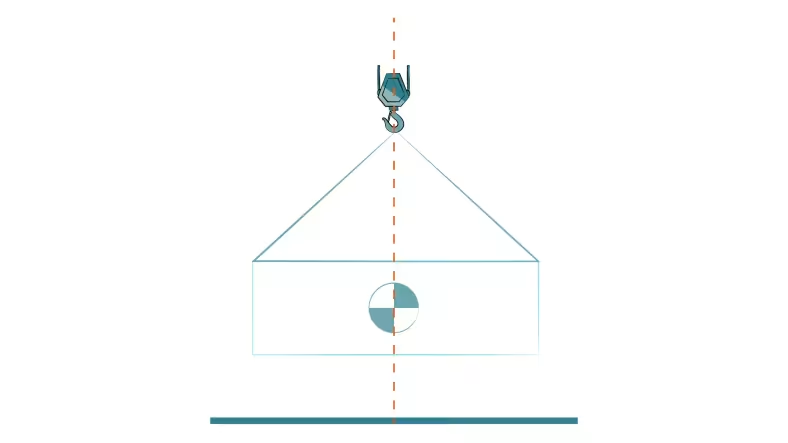
The center of gravity is the point around which the load’s weight is effectively balanced.
For a simple, uniform steel plate, that point may sit close to the geometric center. An industrial machine can look rectangular from the outside while having most of its mass concentrated around a motor, gearbox, transformer core, compressor, or other component on one end.
That difference becomes obvious when the rigging takes weight.
A freely suspended load tends to reposition until its center of gravity sits vertically below the suspension point. If the crane hook is offset from that line, the load can tilt or rotate as it comes free of its supports.
That movement may alter sling angles, shift force between lifting points, reduce clearances, or place the load in an orientation the crew did not expect.
For an irregular load, identifying the center of gravity before the pick helps the team design the rigging around the load’s actual balance rather than its appearance.
Lift Points Determine Where Rigging Forces Enter the Load
A lifting lug is more than a convenient place to attach a shackle.
The location of each approved lifting point determines how force enters the equipment or structure. Its position relative to the center of gravity affects how much load that point may carry and how the suspended object will orient itself.
Manufacturer-designed equipment may come with specific lifting eyes, lugs, pockets, or rigging instructions. Fabricated structures may have lifting points established by the design or erection plan. Other loads may require a project-specific rigging solution.
The presence of four lifting points does not automatically mean each one is intended to carry one quarter of the total weight.
The rigging team also needs to consider whether the planned loading direction matches how the point is intended to be used. A connection that works well with a largely vertical force may behave differently when the rigging introduces substantial side loading.
This is one reason Aerial Crane Service’s rigging services review the load weight, center of gravity, lifting points, dimensions, shape, site conditions, and final placement together rather than selecting hardware from weight alone.
Equal Pick Points Do Not Guarantee Equal Load Sharing
A symmetrical rigging arrangement can still carry an asymmetrical load.
Imagine a long machine lifted from one point near each end. If most of the machine’s mass sits closer to the left lifting point, the left side has to support more of the weight. Moving the lifting points equal distances from the ends does not move the machine’s center of gravity.
The same problem can appear in multi-point rigging.
Small differences in geometry, sling length, structural stiffness, lifting-point elevation, and center-of-gravity location can change how force is shared between sling legs. A plan should not assume that four connected legs automatically divide the load into four identical reactions.
This matters when a lifting lug, shackle, or sling has less margin than the total crane capacity might suggest.
The rigging plan needs to address the most heavily loaded part of the system rather than relying on an average.
Sling Angle Can Increase Tension Without Changing the Load Weight
Sling geometry changes force.
When sling legs become flatter, each leg has to develop more tension to provide the same vertical lifting force. The load may still weigh exactly the same amount, but the forces inside the rigging system rise.
This is why a sling’s working load limit cannot be treated as one universal number regardless of configuration.
OSHA requires wire-rope sling identification to include rated capacity for the type of hitch and the angle on which that rating is based. Synthetic and other sling types also have configuration-specific capacity requirements.
A tight overhead clearance can make this issue more pronounced. If the crane hook cannot rise high enough to create favorable sling geometry, simply shortening the headroom may produce flatter sling legs and greater tension.
At that point, changing the rigging geometry may make more sense than choosing heavier versions of the same arrangement.
Spreader Bars Can Change the Geometry, but They Do Not Fix a Weak Lift Point
A spreader bar can help keep lower sling legs more vertical, distribute forces among multiple attachment points, protect wide or delicate equipment, and control the orientation of long loads.
It does not increase the structural capacity of a lifting lug.
If one attachment point cannot safely carry the force assigned to it, placing a spreader above that point does not make the underlying connection stronger. The device needs to be part of a rigging arrangement that produces acceptable forces throughout the entire load path.
Lifting beams and spreader bars can also solve different geometric problems, so the device should be selected around the actual load rather than treated as interchangeable hardware.
Aerial Crane Service provides spreader bars and specialty rigging for loads where shape, weight distribution, limited lifting points, or installation requirements make a standard sling arrangement a poor fit. The company’s published process begins with the load and attachment points before selecting the below-the-hook equipment.
A Controlled Initial Lift Checks Whether the Load Behaves as Planned
Once the configuration is established and the rigging takes tension, the first movement can reveal whether the actual load behaves like the planning information predicted.
A controlled initial lift may be used to check whether the load comes free evenly and maintains the intended orientation. If it begins to tilt unexpectedly, the safer response is to return it to a supported position and resolve the imbalance rather than continuing upward and hoping it settles.
That check is confirmation, not a substitute for planning.
A trial lift should not be used to discover whether an unknown lifting lug is strong enough or whether unmarked rigging can carry the load.
Different Loads Create Different Rigging Problems
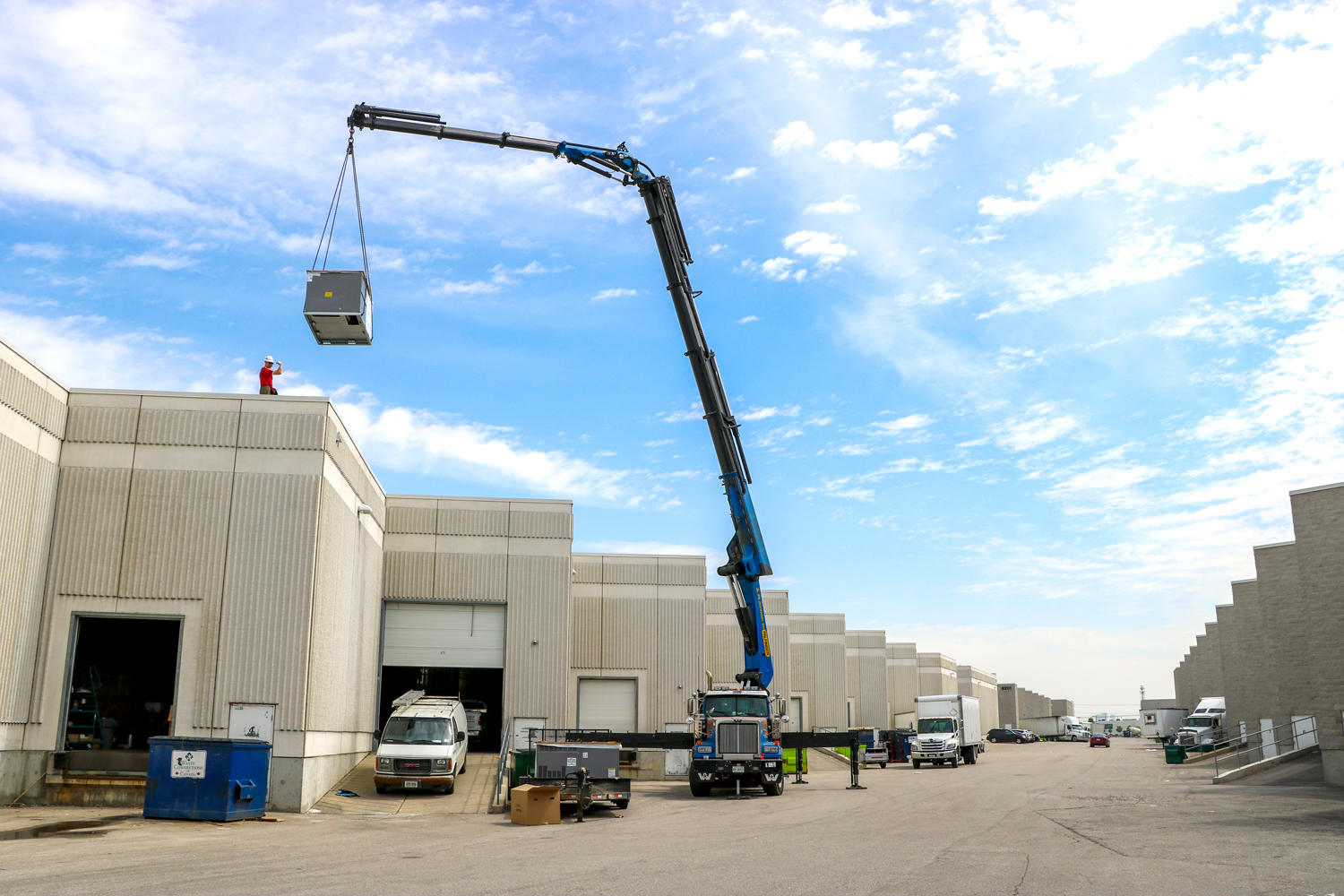
A rooftop HVAC unit may have a cabinet that looks balanced while compressors and other components shift the center of gravity to one side. Manufacturer lifting instructions can also require particular lift points or spreader arrangements. Aerial supports these projects through its HVAC crane lift service.
Generators are compact but can have uneven internal weight distribution and specific manufacturer lifting points. The final orientation may matter as much as getting the unit off the truck, particularly when the equipment has to land on a prepared pad or inside a confined installation area. Aerial’s generator placement service addresses that type of equipment setting.
Transformers bring their own lifting instructions, attachment points, weight distribution, and placement constraints. A rigging arrangement suitable for another electrical component should not be assumed to fit a transformer of similar total weight. Aerial also provides transformer installation crane support.
Long structural components raise different questions. A steel member may require multiple pick points to control orientation and limit unwanted deflection while it is moved into position. Those considerations appear in Aerial’s steel erection crane service.
Industrial machinery can combine nearly all of these issues: an offset center of gravity, sensitive surfaces, limited lifting locations, low overhead clearance, and a narrow final placement zone. Aerial works with plant and facility teams through its industrial facility crane service for machinery, process equipment, generators, transformers, tanks, and related equipment.
A Rigging Plan and a Crane Lift Plan Answer Different Questions
The rigging plan concentrates on how the load connects to the lifting system.
It addresses the load weight, center of gravity, lifting points, slings, shackles, spreaders or lifting devices, geometry, load balance, and expected forces.
The broader crane lift plan also has to account for where the crane sets up, working radius, boom configuration, ground conditions, overhead hazards, lift path, communication, weather, and placement area.
The two plans meet at the hook.
A sound rigging arrangement cannot compensate for a crane that lacks capacity at the required radius. A properly sized crane cannot compensate for an overloaded sling leg or unsuitable attachment point.
Both sides need to agree with the same load information.
What Information Helps Build a Better Rigging Plan?
Contractors can reduce uncertainty by sending useful load information before the crane mobilizes:
- exact or reliably established load weight;
- overall dimensions;
- manufacturer drawings or lifting instructions;
- known center-of-gravity information;
- location and type of approved lifting points;
- photographs showing the load and its attachment points;
- whether the load has been modified from its original configuration;
- required orientation during the lift and at placement;
- pickup and final set locations;
- overhead or side-clearance restrictions;
- delivery or support arrangement beneath the load;
- and any project-specific lift-plan requirements.
If a detail is unknown, identify it as unknown rather than substituting an estimate that looks reasonable.
That gives the rigging team a chance to determine whether the missing information has to be resolved before equipment is selected.
Rigging Support Across New England
Aerial Crane Service has provided crane lifting since 1983 and currently offers crane and rigging support across New Hampshire, Massachusetts, Maine, and Vermont. Its rigging service covers construction, industrial, HVAC, utility, generator, transformer, structural steel, precast, and specialty lifting projects.
The company also serves contractors through its local crane operations in Wilmington, Massachusetts and White River Junction, Vermont, along with other communities throughout its New England service area.
If an upcoming lift involves an offset center of gravity, unusual lifting points, sensitive equipment, or a load that may require specialty rigging, provide the load drawings, weight, dimensions, attachment information, project location, and placement requirements before scheduling. Aerial Crane Service can be reached at (603) 491-1268 to review the lift.