
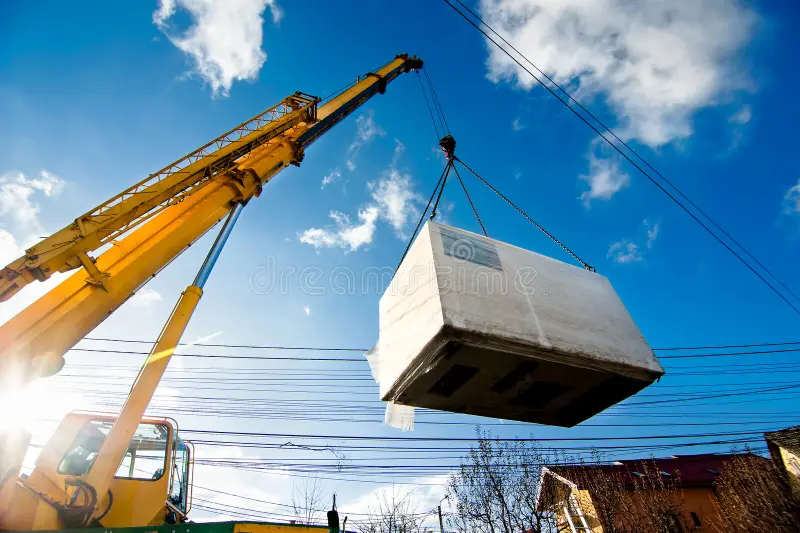
Searching for crane rental near me should start with the lift details, not a guess at crane tonnage. Before a contractor books a machine, the crane company needs to know what is being picked, its verified weight and dimensions, how far the crane must reach, where it can set up, what the ground and access look like, how the load will be rigged, and when every crew involved will be ready.
A 40-ton crane is not automatically right for a 20,000-pound load, and a 120-ton crane does not lift 120 tons at every boom length and working radius. Crane selection comes from the complete lift geometry and jobsite conditions.
Getting that information settled before mobilization is one of the easiest ways to avoid discovering the wrong problem after the crane is already on site.
Confirm the Load Before Asking for a Crane Size
The most useful booking information starts with the load itself.
Contractors should provide an actual weight whenever one is available from manufacturer specifications, engineering drawings, shipping documents, equipment data, or another reliable source. Estimating by appearance gives the crane company a poor starting point.
Dimensions matter as well because a compact piece of machinery and a long steel member can behave very differently even when they weigh the same amount. The provider also needs to understand available lifting points, expected center of gravity, final orientation, and whether the job involves one pick or a sequence of loads.
For an HVAC replacement, for example, the old rooftop unit and the replacement unit may have different dimensions and rigging points. A contractor should not assume the same setup works simply because the weights are close.
Aerial Crane Service’s guide on how to plan a safe crane lift begins with load weight, dimensions, center of gravity, lifting points, stability, and rigging requirements for this reason.
Good crane selection starts with information the operator can plan around.
Working Radius Can Change the Crane Choice More Than the Load Weight Suggests
Contractors often know the height of the building but have a much rougher idea of working radius. That can be the measurement that changes the job.
Working radius is the horizontal distance between the crane’s center of rotation and the load. The crane has one radius at the pickup point and may have another when the load reaches its final location.
As that distance increases, available lifting capacity can change substantially. Boom length, configuration, counterweight, setup, and other factors enter into the same calculation.
This is why asking for “a crane that can lift 15 tons” does not fully describe a project. Fifteen tons close to the crane is a different lift from fifteen tons placed well across a roof.
Aerial’s fleet shows how varied the equipment can be. Its National 800D boom truck is listed with a maximum capacity of 23.5 US tons and an 80-foot boom, while the Liebherr LTM 1090-4.2 is listed at 120 US tons with a 197-foot boom.
Those headline specifications help describe the fleet. They do not replace the load chart or project review for a particular pick.
Give the crane company measurements and let the lift requirements determine the equipment.
Make the Crane Setup Area Part of the Booking Conversation
Knowing where the load will land is only half of the site plan. The crane also needs a usable place to sit.
Photos should show the proposed setup area, not just the building and load.
The provider needs to know whether the surface is pavement, gravel, compacted fill, lawn, recently disturbed soil, or another condition. Slope, drainage, nearby excavations, retaining walls, underground structures, and limited outrigger space can all affect setup.
A spot that looks firm from the truck may have a tank, utility vault, old excavation, or other weakness below it.
For construction work covered by OSHA’s crane standard, ground conditions must support the equipment according to the manufacturer’s requirements. The controlling entity also has responsibilities for providing necessary ground preparation and communicating known subsurface hazards in the setup area.
That makes ground support something to discuss before the crane arrives, particularly when the general contractor controls the site.
Do not rely on “the ground should be fine” as the handoff.
If there are drawings showing underground utilities, tanks, filled areas, vaults, or previous excavation, bring that information into the lift discussion.
Show the Entire Access Route, Not Just the Final Crane Position
The crane has to reach the setup point before it can make the lift.
For a local crane rental, access can be straightforward on a large commercial lot or much tighter on an occupied property. Gates, narrow entrances, parked vehicles, low branches, soft shoulders, turning space, loading docks, construction fencing, and other trades can change how equipment enters and leaves.
Street access matters too.
A machine that physically fits the setup area still needs enough room to get there, deploy its outriggers or stabilizers, handle supporting equipment, and demobilize afterward.
Overhead conditions deserve their own photos. Power lines, building projections, trees, signs, temporary structures, and other obstructions can affect boom movement or the load path.
Power lines should never be treated as another item to squeeze past. OSHA’s construction crane rules require an assessment when the equipment, load line, load, or rigging could approach energized lines within the work zone, with precautions based on the line conditions and voltage.
If utilities are anywhere near the proposed crane or load path, flag them before booking.
Confirm What Crane and Crew the Rental Actually Includes
“Crane rental” can describe different arrangements in the market, so the contractor should know what is being supplied.
Aerial Crane Service says its rentals typically include experienced crane operators. Contractors should still confirm the exact scope for their project, including who provides the operator, rigging personnel, signal person, lift direction, and any other personnel the job requires.
Under OSHA’s construction crane rules, covered operators must meet training, certification or licensing, and employer evaluation requirements. Signal persons and rigging work can carry their own qualification requirements depending on what they are doing.
The GC should not assume that every person needed for the lift is automatically included because an operated crane was booked.
Aerial’s crane rental for general contractors is built around jobsite coordination with project managers, superintendents, steel crews, roofers, mechanical contractors, and other trades. That coordination becomes easier when everyone knows their role before lift day.
Rigging Should Be Confirmed Before the Load Is Waiting on the Hook
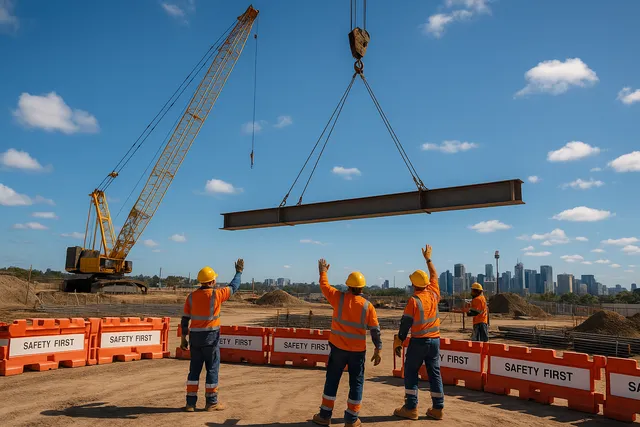
The crane may have enough capacity and reach while the rigging plan still needs work.
Loads with approved lifting lugs may be straightforward. Long, delicate, flexible, unusually shaped, or unevenly balanced loads can require different sling arrangements, spreader bars, lifting beams, or specialty hardware.
This should be discussed using the actual load information.
For equipment such as rooftop mechanical units, contractor and manufacturer documentation can help establish weight, lifting points, dimensions, and restrictions before the rigging is selected.
Aerial provides dedicated rigging services and also lists spreader bars and specialty rigging for loads where standard arrangements are not enough.
Before accepting a quote, ask what rigging is expected, what equipment is supplied by the crane company, and whether the contractor needs to provide any load-specific lifting devices or documentation.
That conversation is much cheaper before mobilization than while several trades are waiting for a pick that cannot begin.
Compare Crane Quotes by Scope Instead of the Hourly Number Alone
Two crane quotes can show different prices because they describe different jobs.
Before comparing them, find out what the number includes.
A contractor may need to clarify mobilization and travel, setup time, crane and operator time, rigging, specialty lifting equipment, support vehicles, mats or cribbing, standby time, overtime, permits, traffic control, police details where applicable, and demobilization.
Not every project uses all of those items, and not every crane company bills them the same way.
Weather and delays deserve specific language too. If a delivery truck arrives late, does the clock continue? What happens if another trade prevents the lift from starting? How is a weather cancellation or reschedule handled?
Aerial Crane Service does not publish a universal hourly minimum or one standard rate structure on its current site, so contractors should get the commercial terms for their actual project instead of applying an online “average” to the job.
The better comparison is the total scope needed to complete the lift.
Coordinate the Crane With the People and Material It Is Waiting For

Crane time becomes expensive when the rest of the project is not ready.
The material should be on site or arriving within a coordinated window. The receiving crew should be ready. Roof access, steel connections, temporary bracing, mechanical crews, delivery drivers, building access, and other work that affects the pick should be settled before the crane’s scheduled start.
HVAC projects make this easy to see. Removing one unit and setting another may involve the crane operator, mechanical contractor, delivery driver, roof crew, electrician, facility representative, and sometimes traffic or tenant coordination.
Aerial’s HVAC contractor crane service specifically addresses the need to coordinate equipment deliveries, roof access, installation crews, electricians, building management, and site restrictions.
The same principle applies to steel, precast, generators, transformers, and other contractor work.
Aerial currently recommends scheduling several days to a week ahead when possible, while noting that urgent work may sometimes be accommodated depending on availability.
The booking date should represent a coordinated lift window, not simply an open space on one subcontractor’s calendar.
Settle Permit and Traffic Responsibilities Before Lift Day
Local crane rental can involve public streets, sidewalks, parking lanes, active facilities, or restricted access.
Permit requirements vary by municipality and project. Aerial’s own FAQ notes that some New Hampshire lifts may require permits depending on location and type of work.
The contractor should determine early whether the planned crane position or work zone affects public property and who will handle any required municipal coordination.
The same applies to traffic control.
Do not assume the crane company automatically supplies traffic-control labor, police details, barricades, or permit paperwork unless those items are part of the confirmed scope.
This matters even more when working in tighter locations. Aerial’s crane service in Nashua, NH and crane service in Portsmouth, NH both identify traffic, pedestrian activity, overhead utilities, restricted setup space, and scheduling windows as factors that can affect planning.
A few questions during estimating can prevent a lane closure from becoming a lift-day surprise.
Have a Weather and Change Plan Before Everyone Mobilizes
Wind affects suspended loads differently depending on their size and shape. Large panels, trusses, ductwork, rooftop equipment, and other broad loads can present considerably more surface area than a compact object of similar weight.
Rain, snow, ice, visibility, lightning, and changing ground conditions can matter too.
The contractor does not decide whether a crane should operate outside its allowable conditions. The operator and responsible lift personnel work within manufacturer limits, applicable requirements, and actual site conditions.
What the contractor can settle beforehand is the commercial and scheduling side of a weather delay.
Know who makes the call, when the project team will be notified, what happens to deliveries, how another lift window is scheduled, and whether standby or remobilization charges may apply.
New England projects have enough moving pieces without inventing the weather policy on the morning of the job.
Build a Simple Crane Booking Packet
Before contacting a crane rental company near you, put the information in one place so the provider is evaluating the actual job rather than filling gaps with assumptions:
- Exact job address and onsite contact
- Load description, verified weight, dimensions, center of gravity information, and manufacturer lifting points when available
- Pickup location, final set location, approximate working radius, and required height
- Photos or drawings showing the proposed crane setup and load path
- Access route, gates, street conditions, turning limitations, and available setup space
- Ground surface plus known underground utilities, vaults, tanks, excavations, or other subsurface conditions
- Power lines, structures, trees, traffic, pedestrians, and other overhead or work-zone restrictions
- Number of picks, planned sequence, requested date, delivery timing, and expected onsite duration
- Known rigging requirements and any specialty lifting devices
- Current permit, traffic-control, utility-coordination, and site-access status
That packet does not replace the crane company’s planning. It gives the operator and estimator better information to plan from.
It also gives the contractor one set of project facts to share with the superintendent, equipment supplier, mechanical crew, steel contractor, delivery driver, or anyone else involved in the pick.
Finding Local Crane Rental Across New England
Aerial Crane Service is based in Bow, New Hampshire and provides crane lifting across New Hampshire, Massachusetts, Maine, and Vermont. Its current fleet includes boom trucks and larger mobile and all-terrain cranes for work ranging from rooftop equipment and construction materials to structural steel, industrial machinery, generators, transformers, precast concrete, bridge components, and specialty lifts.
Contractors working across the region can review Aerial’s broader New England crane service coverage to confirm where project support is available.
When the next search is “crane rental company near me,” have the lift information ready before asking for a machine. Aerial Crane Service can review the load, radius, access, ground conditions, rigging needs, and schedule to determine what equipment fits the job. Contractors can discuss an upcoming lift at (603) 491-1268.