
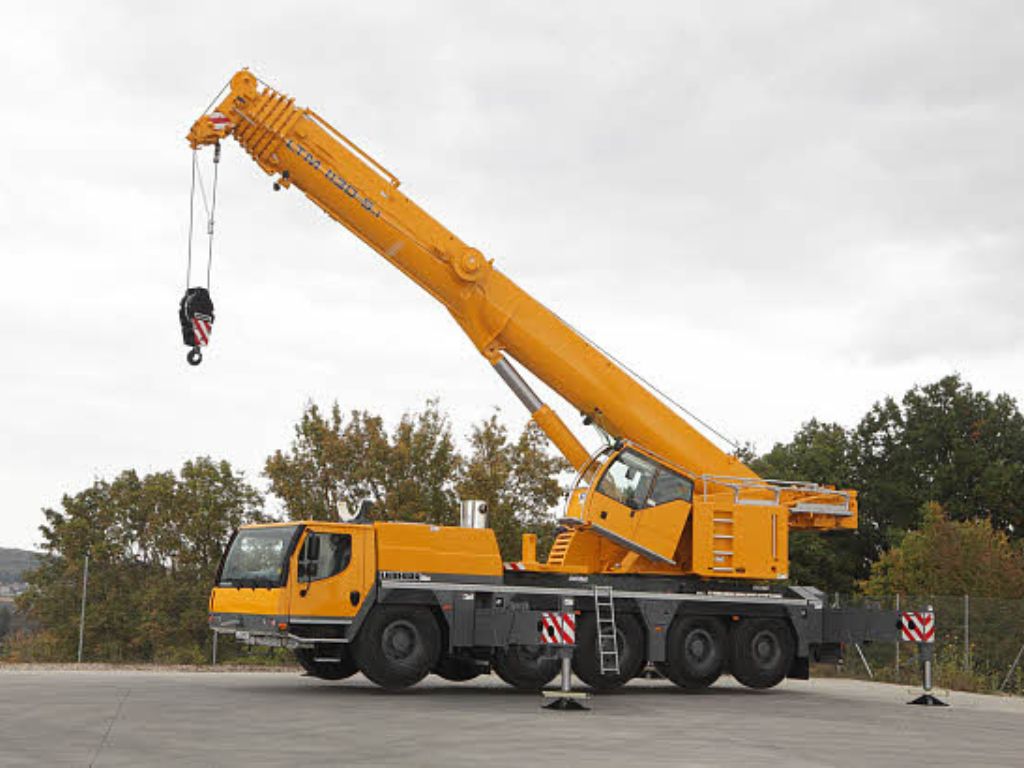
If you are asking what size crane do I need, the load weight alone cannot answer it.
You need to know what will be suspended from the crane, how far the crane must reach, how high the load has to travel, and where the crane can actually set up.
A 5,000-pound HVAC unit lifted from directly beside a building can require very different equipment from the same unit placed on a roof from across a parking lot.
The crane’s nameplate tonnage is the starting point.
The load chart for the actual radius and configuration decides whether the lift works.
A 100-ton crane does not lift 100 tons everywhere
This is the first number to stop taking literally.
When a mobile crane is described as a 40-ton, 120-ton or 145-ton crane, that number is its maximum rated capacity under a specific configuration and operating condition.
Move the load farther from the crane and the available capacity changes.
Extend the boom.
Change the outrigger configuration.
Change counterweight.
The applicable chart value can change again.
OSHA requires cranes to operate within their rated capacity and requires the applicable rated capacities, or load charts, to be available to the operator.
That is why we do not size a lift by saying, “The unit weighs 10 tons, so send a 10-ton crane.”
Start with the actual lifted weight
The equipment weight is the first piece of information we need.
For an HVAC unit, use the manufacturer’s actual unit or shipping weight when possible.
For a generator or transformer, confirm the weight for the exact model and configuration.
For structural steel, weight may come from fabrication drawings, shipping documents or calculation from known dimensions and material weights.
OSHA requires the operator to verify that the load is within the crane’s rated capacity using a recognized source, accepted calculation method or another permitted method.
“About 8,000 pounds” is less useful than a manufacturer sheet showing 8,240 pounds.
The equipment weight is not always the entire chart deduction
A load does not hang directly from the boom tip.
There may be:
- a hook block;
- slings;
- shackles;
- spreader bars;
- lifting beams;
- other load-handling equipment.
How those items are treated must match the manufacturer’s load chart and its notes.
For the Liebherr LTM 1130-5.1, for example, the manufacturer notes state that hook blocks and hooks are part of the load and their weight must be deducted from the published lifting capacities.
For planning purposes, give the crane company the object weight and tell us what rigging is expected.
We can account for the configuration against the correct chart.
Working radius usually changes the answer faster than contractors expect
Working radius is the horizontal distance from the crane’s center of rotation to the load line at a given point in the lift.
It is not:
- the distance from the truck bumper to the building;
- the distance from the outrigger to the unit;
- or simply the width of the parking lot.
The crane rotates around its slewing center, so that is the reference used by the load chart.
A few feet can matter when a lift is already near the edge of a chart range.
Measure to the final set point, not just the building wall
Suppose an HVAC unit is going onto a flat roof.
The crane may sit 20 feet from the building.
The final curb may be another 35 feet across the roof.
That does not create a 20-foot lift radius.
The load still has to reach the rooftop set point.
The crane company needs the horizontal relationship between the crane’s possible setup position and the location where the load will actually hang.
For rooftop work, a site plan, roof plan or marked-up aerial image can be far more useful than saying “the building is about 50 feet wide.”
Pick radius and set radius can be different
The crane may pick the load from a delivery truck on one side and place it at another radius.
The longer radius may occur at the pick.
It may occur at the set.
It can also occur while the crane swings the load around a corner or obstruction.
The sizing check has to cover the lift path that will actually be used.
Do not size the crane from the easiest point in the operation.
Lift height is not the same as boom length
A load needs to clear whatever sits between the pick and set points.
That could be:
- a roof parapet;
- another section of building;
- steel framing;
- a mechanical penthouse;
- trees;
- temporary construction;
- existing equipment.
The boom works at an angle while also providing horizontal reach.
Rigging hangs below the hook.
The load itself has height.
The boom tip and hoist system still need operating clearance.
Because of that geometry, a 70-foot roof elevation does not mean “we need a 70-foot boom.”
Load dimensions can matter even when the weight is low
A large rooftop unit may be relatively light for the crane.
Its dimensions can still change the lift.
A long or wide object may require different rigging.
Its center of gravity may not sit in the physical center.
A large surface area can respond more strongly to wind.
It may need more clearance around the building while swinging.
This is why we ask for dimensions along with weight.
A compact 5,000-pound machine and a broad 5,000-pound rooftop assembly can create different planning problems.
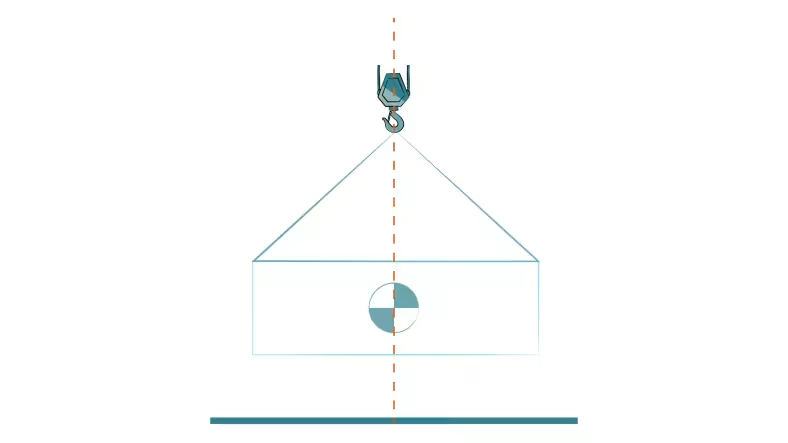
Center of gravity affects how the load hangs
Knowing the load weight tells us how much force is being lifted.
Knowing the center of gravity helps determine how that load will behave when suspended.
If lifting points are not evenly positioned around the center of gravity, sling loads and load attitude can change.
Equipment manufacturers sometimes identify lifting points and center-of-gravity information in their documentation.
Send those drawings when you have them.
For unusual machinery, custom assemblies or loads with uncertain balance, rigging needs to be reviewed before the crane is selected.
Rigging height can increase the required hook height
A spreader bar or long sling arrangement takes up vertical space.
If the load has to clear a parapet and then land onto a rooftop curb, that rigging geometry matters.
A lift can have enough crane capacity on paper while lacking comfortable hook height for the planned arrangement.
When we ask how high the load needs to go, we are thinking about the complete suspended assembly and its required clearance.
The crane has to fit on the site before its chart matters
A larger crane can have plenty of theoretical capacity and still be the wrong choice if it cannot set up where the plan assumes.
We look at:
- access width;
- turning room;
- crane setup footprint;
- outrigger space;
- traffic;
- parked vehicles;
- fences;
- buildings;
- slopes;
- underground structures;
- overhead utilities.
The theoretical “best crane” from a calculator is useless if it cannot enter the site or deploy in the required configuration.
Outrigger position can change available capacity
Mobile crane load charts can be configuration-specific.
The crane may have different ratings depending on how the outriggers are deployed and what operating area is being used.
That means a site where the crane can fully set its outriggers can produce a different answer from a tight street where deployment is restricted.
The correct chart must match the real setup.
Do not assume you can select a crane using a full-outrigger chart and then reduce the footprint after it arrives.
Ground conditions are part of crane sizing
The crane has to transfer its loads into the ground.
OSHA requires crane ground conditions to be firm, drained and graded enough to meet manufacturer requirements, using mats, blocking or other supporting materials when needed.
A setup area can look like a large open parking lot and still contain problems.
Below the pavement there may be:
- utility structures;
- old trenches;
- vaults;
- tanks;
- poor fill;
- drainage structures.
For construction work, known underground hazards in the setup area need to be communicated to the crane user and operator.
A bigger crane can create a bigger setup problem if the site cannot support or accommodate it.
A concrete slab is not automatically a crane pad
Commercial parking pavement was often designed for vehicle traffic, not concentrated outrigger reactions.
The same applies to sidewalks, loading areas and slabs over underground spaces.
Before treating a paved area as an acceptable setup point, find out what is underneath it.
This becomes particularly important around hospitals, industrial facilities, downtown buildings and older commercial sites where utility structures may not be obvious at the surface.
Power lines can eliminate the setup position you planned to use
A contractor may measure the shortest radius from one side of the building and assume that is where the crane should go.
Then we see overhead power lines.
Now the setup may have to move.
OSHA requires a work-zone assessment when crane equipment, load line or load could come within specified distances of energized power lines.
Moving the crane away from the lines can increase radius.
That may increase the crane size needed for the same load.
Building height can be less important than building width
People often call and lead with the number of stories.
That is useful.
It does not tell us the whole lift.
A three-story building with a wide roof can demand more reach than a taller building where the crane can set directly beside the final placement point.
For many rooftop lifts, horizontal distance drives the equipment choice as much as vertical height.
This is why roof plans and setup photos help.
A crane load chart is a configuration document
A useful crane load chart connects variables such as:
- working radius;
- boom length or boom angle;
- rated capacity;
- outrigger configuration;
- counterweight;
- reeving;
- attachments or extensions;
- operating area.
Manufacturer notes then add conditions and deductions that apply to those numbers.
OSHA requires manufacturer procedures and rated capacities to be followed and available to the operator.
Reading one capacity number outside its chart configuration is not enough.
The chart value is a limit, not a target weight
If the chart shows a rated capacity at a particular configuration, that value is the maximum permitted by that chart under its stated conditions.
The correct approach is not to increase the published capacity with an informal calculation because the job “is close.”
OSHA prohibits operating above rated capacity.
Project procedures may also classify lifts differently when they use a high portion of crane capacity or involve other complexity.
Those requirements depend on the project and employer.
Do you need to add a 10% or 20% safety margin?
You will find online crane guides that tell readers to add a fixed percentage to the load.
That is too simplistic for mobile crane selection.
We use the manufacturer load chart and the planning requirements that apply to the job.
If a contractor, owner or facility has a critical-lift policy based on capacity utilization, that requirement belongs in the plan.
A generic percentage from an online article should not replace the crane’s chart.
Online crane calculators are screening tools
A crane size calculator can help you understand why a load at 100 feet needs a different machine than the same load at 25 feet.
It can also help rule out obviously undersized equipment.
It cannot see:
- where the outriggers will fit;
- whether the pavement covers a utility vault;
- whether a parapet changes boom clearance;
- the actual rigging weight;
- power lines;
- traffic restrictions;
- the manufacturer’s exact setup that will be used.
Use calculators to understand the problem.
Use the assigned crane’s official chart and job-specific plan to select equipment.
Boom truck vs. mobile crane starts with the same measurements
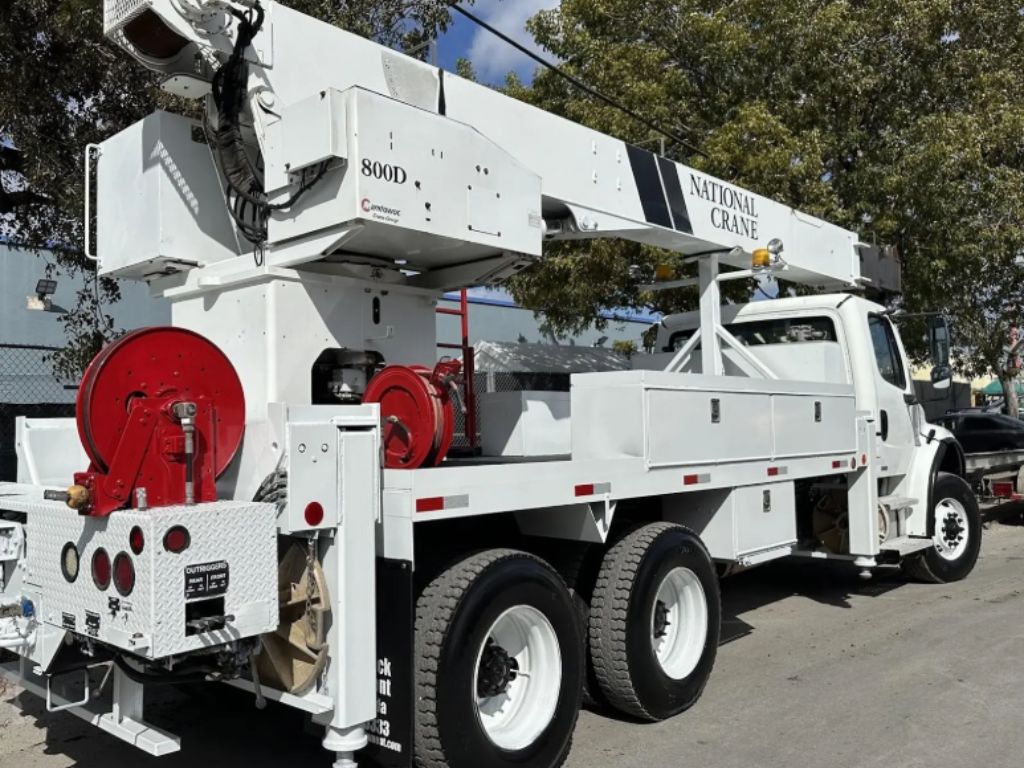
A boom truck can be a good fit when the load, radius and required height fall within its chart and the site favors its mobility.
A larger hydraulic mobile crane becomes appropriate when the job requires more capacity, more reach or a different configuration.
Aerial Crane Service’s boom truck service includes commercial construction, HVAC, utilities, generators, signs and material handling. We evaluate load, site layout, radius, ground and placement requirements before assigning it.
The type of item does not decide the crane by itself.
Our National 800D is a 23.5-ton boom truck
The National 800D in our published fleet has a maximum capacity of 23.5 US tons and an 80-foot hydraulic boom.
That does not mean it can lift 23.5 tons at 80 feet.
Maximum capacity and maximum boom length are separate specifications.
For a specific job, we still need the load chart at the expected radius and configuration.
This boom truck can be a practical option for appropriate HVAC, utility, generator, sign and commercial work where its chart and site layout fit the job.
The Grove TMS500E adds another mobile-crane option
Our Grove TMS500E is a truck-mounted hydraulic crane with a maximum published capacity of 40 US tons, a 95-foot main boom and up to a 45-foot jib.
It serves many HVAC, generator, utility, light structural and commercial lifts.
Again, “40 ton” describes the crane class.
The usable crane capacity at radius comes from the chart for that setup.
A 10,000-pound unit may fit comfortably on one job and require a larger crane on another because the set point moved farther away.
Two 120-ton cranes can still be different choices
Our published fleet includes the Liebherr LTM 1100-5.2 and LTM 1090-4.2.
Both are listed in the 120 US ton class.
The LTM 1100-5.2 has a 171-foot telescopic boom.
The LTM 1090-4.2 is published with a 197-foot boom.
That alone shows why tonnage does not completely define a crane.
Two machines carrying the same maximum-capacity label can have different boom geometry, charts, dimensions and setup characteristics.
The project decides which one makes sense.
Our largest published crane is the LTM 1130-5.1
The Liebherr LTM 1130-5.1 is currently the highest-capacity crane listed on our site, with a maximum published capacity of 145 US tons and a 197-foot telescopic boom.
We use this class of equipment for larger commercial, industrial, structural, utility and specialty lifting work where the required capacity and reach move beyond the smaller fleet options.
Its 145-ton rating still does not answer whether it can make a particular lift.
We need the radius and chart.
Bigger is not automatically the better rental
An oversized crane can require more setup area.
Mobilization can be more involved.
A larger footprint may interfere with traffic or other contractors.
The site may not allow the setup position that makes the larger crane useful.
If a smaller machine handles the complete lift within the applicable chart and job requirements, sending a larger crane does not automatically improve the plan.
The goal is to assign equipment that fits the load and the site.
An undersized crane creates a different problem
If the selected crane lacks capacity at the actual radius, there are only a few ways the job changes.
The crane may need to move closer.
The load path may need to change.
A different configuration may be needed.
Or a larger crane may have to be mobilized.
Those changes are much easier to solve before lift day.
That is why rough guesses about radius cost more than a few minutes spent measuring the site correctly.
HVAC lifts are often reach problems
An HVAC contractor may have a 2,500-pound rooftop unit and assume a small crane will handle it.
Then we learn the crane has to set across a parking lane, sidewalk and landscaping strip.
The final curb is another 40 feet back from the roof edge.
Now the question has little to do with whether a crane can lift 2,500 pounds close to itself.
We need to know whether it can lift the complete suspended weight at the actual rooftop radius with the boom configuration required to clear the building.
Steel erection can have several controlling picks
A structural job may include dozens of members.
The heaviest beam may not be the piece that determines crane size.
A lighter member placed at the far corner of the building can create a more demanding chart condition.
Before selecting the crane, identify both the heavy pieces and the far reaches.
If the crane will reposition during the job, each setup may have a different controlling pick.
Generators and transformers need verified weights
Electrical equipment can be compact and heavy.
Do not estimate from physical size.
Use manufacturer documents or shipping information for the exact unit.
Also confirm whether accessories are installed during the lift.
Fuel, fluids, enclosures, skids or attached components can change the lifted weight from a generic product specification.
Reliable load information is needed before checking the crane against its rated capacity.
Modular sections introduce size and rigging geometry
A modular section is not a point load.
Its dimensions, pick points and balance affect the rigging arrangement.
The crane also needs enough radius to move the section from its delivery position onto the foundation.
Trailer placement matters because a poorly staged module can create unnecessary reach before the set even begins.
For this type of work, crane setup and delivery logistics should be planned together.
Wind matters more for some loads than the scale suggests
A broad panel, rooftop unit, tank or modular component can present more surface area to the wind than a compact load of the same weight.
Wind, ice and snow conditions can affect crane operation, stability and the ability to complete a lift within manufacturer requirements.
Manufacturer procedures and load-specific restrictions also apply.
This is another reason a weight-only calculator cannot approve a lift.
A jib increases reach, but it does not preserve main-boom capacity
Jibs and boom extensions can help reach higher or farther positions.
They have their own charts and configurations.
Do not take the main-boom capacity at a certain radius and assume the same number applies after adding an extension.
The applicable manufacturer chart must match the attachment and setup being used.
The same principle applies to boom length, counterweight and outrigger position.
Crane reach requirements should include the load path
The final point matters.
So does the route to get there.
If a unit must clear an existing rooftop penthouse, the hook may need to rise higher before moving horizontally.
If a beam has to pass beside a structure before being swung into position, the boom or load may encounter an obstruction before reaching the final radius.
Our safe crane lift planning process includes load path, crane setup, site hazards and communication before the load leaves the ground.
Photos can answer questions that dimensions miss
When you contact us, site photos are useful.
Stand far enough back to show:
- the building;
- possible crane setup area;
- access road;
- overhead lines;
- trees;
- fences;
- parking;
- the approximate pick and set locations.
Close-up photos of the load label help too.
A photo showing only the HVAC unit tells us the object.
A wider photo tells us whether a crane can reach it.
Aerial images help with preliminary radius planning
An aerial image can give us a better sense of building shape, parking areas and possible crane positions.
Mark the pick location.
Mark the set location.
Mark where you believe the crane can sit.
That gives us a starting geometry.
It is still preliminary because an aerial view will not show every overhead line, underground hazard, slope or height difference.
The site information still has to be confirmed.
A site visit may change the crane class
Some lifts can be sized from reliable drawings, measurements and photos.
Others deserve a job walk.
Tight urban access, long rooftop reaches, unusual rigging, industrial facilities and uncertain ground conditions can all change the answer.
The purpose of the visit is not to make the lift sound more complicated.
It is to replace assumptions with usable dimensions.
What information should you send for a crane quote?
If you want us to answer what crane size do I need, send:
- job address;
- object description;
- verified or best available load weight;
- load dimensions;
- manufacturer drawing when available;
- approximate pick location;
- final set location;
- building or placement height;
- photos of the setup area;
- known overhead lines or obstructions;
- preferred lift date.
If you already know the working radius, send it.
If you do not, give us enough site information to help determine it.
What if you do not know the weight?
Do not invent one.
Send the model number, equipment data sheet, drawing or other documentation you have.
For fabricated items, the contractor or fabricator may be able to provide calculated weight.
For machinery, the manufacturer may have shipping or installed weights.
The earlier we identify uncertainty in the load, the easier it is to resolve before the crane is scheduled.
What if you do not know the radius?
That is common.
Give us the job address and show us where the crane may be able to set up.
Measure known building dimensions when possible.
Mark the final placement point.
We can work from those details to develop a preliminary radius and determine whether more site information is needed.
A bad guessed radius is worse than saying you do not know yet.
What if the crane cannot get close enough?
Then the equipment decision changes.
A longer reach may require a larger mobile crane even though the load stays exactly the same.
Another option may be finding a different setup position.
Sometimes site logistics can be adjusted before crane day to create a better location.
Moving stored materials, reserving parking spaces or coordinating traffic can reduce radius enough to change the lift.
That is why crane planning should happen before the site becomes crowded.
Crane tonnage requirements should come after the layout
Contractors often ask us to quote “a 40-ton crane” because that is what they used on another project.
The previous lift may have had a different radius.
It may have had another roof height.
The crane may have been able to set on the opposite side of the building.
Use the last project as background.
Do not use it as the load chart for this one.
How we choose between our crane options
Aerial Crane Service currently publishes lifting equipment from a 23.5 US ton boom truck through 120-ton and 145-ton all-terrain cranes.
We start with the lift rather than the fleet label.
We compare load information, working radius, height, access, setup area and ground conditions to the applicable equipment charts.
That lets us decide whether the project fits our boom truck service or needs one of the larger units available through our mobile crane rental service.
Need help choosing the right crane?
Send us the load weight, job address, approximate lift height and photos showing where the crane could set up.
If you have equipment drawings, roof plans or a site plan, include those too.
Aerial Crane Service provides operated crane service throughout New Hampshire, Massachusetts, Maine and Vermont, with a published fleet ranging from 23.5 to 145 US tons.
Call (603) 491-1268 to discuss the lift.
The number printed on the side of the crane is not the answer to “what size crane do I need?”
The answer is the crane that has the required chart capacity at the actual radius, reaches the required position and can be set up correctly on your site.